Writing one’s biography is one of the most desired—and most frequently postponed—projects there is. Almost everyone, at some point in their life, says to themselves, “One day, I should write down my story.” Then the years go by, memories fade, and that “book of one’s own life” remains an idea that never comes to fruition. Today, artificial intelligence is changing the game, making it possible to write a biography even for those who have never considered themselves writers. In this guide, let’s explore how it really works, what AI can do for you, and what must remain uniquely yours.
Why Write Your Own Biography
The reasons why a person decides to write about their life are almost always deeper than a simple writing exercise:
- Leaving something behind for your children and grandchildren —a firsthand account, in your own words—is worth more than a thousand photos without context
- Reflecting on your own story —writing down important experiences often helps you see them more clearly
- Preserving the memories of those who will no longer be with us —many biographies begin at the initiative of a child or grandchild who wants to record the memories of a parent or grandparent while it is still possible
- To leave behind a legacy that is not merely material —values, stories, decisions made in difficult times: everything that is normally lost over time
In short, the desire is almost always already there. The challenge is to translate it into written pages.
The Challenges of Writing a Biography on Your Own
Those who try to write their own stories without help almost always run into the same obstacles:
The blank page. Knowing that you have eighty years of memories to share and not knowing where to start is perhaps the most common obstacle of all.
Structure. A biography is not a chronological list of events: it needs chapters, a central theme, and decisions about what to explore in depth and what to leave in the background. Organizing all of this on your own requires skills that most people don’t have—and have no reason to have.
Time. Writing a book requires consistency over weeks or months—something that’s hard to maintain without a method or guidance.
Doubts about “how to write.” Many people who have so much to share find themselves at a loss because they don’t feel they have a “knack for writing.” As a result, the story remains only in their heads—or, at best, in a few scattered notes.
How Artificial Intelligence Can Really Help
This is where AI makes a real difference, but it’s important to understand how it helps, because not all AI tools work the same way.
A good AI assistant for writing a biography doesn’t write for you by making up events or details: it asks the right questions, in the right order, to help you recount what would otherwise remain only in your memory. It then takes your answers—even if they’re fragmentary or spoken—and transforms them into a fluid, well-written text organized into chapters.
In practice, the work is divided up as follows:
- You provide the content: memories, facts, emotions, details—in your own words, even if they're a bit jumbled
- AI provides the structure and form: it organizes the text into chapters, poses follow-up questions, and corrects and refines the text
This approach significantly lowers the barrier to entry. You don't need to know "how to write a book"; you just need to know how to answer questions, much like in a long conversation with someone who really wants to hear your story.
What AI Should Never Do in a Biography
There is one point that’s worth making very clear, because it’s the difference between a good tool and one to avoid for this specific purpose: artificial intelligence should never create content for you.
A biography, by definition, must be true. If you use a generic AI tool (any chatbot) and ask it to “write your biography” based on a few pieces of information, there’s a real risk that the AI will fill in the gaps with plausible but made-up details—names, dates, situations that never actually happened that way. For a novel, that’s not a problem. But for the story of your life—or that of a family member—it certainly is.
That’s why tools designed specifically for biographies (unlike a generic chatbot) explicitly state this principle: AI structures and writes well, but the content—every fact, every memory—always and exclusively comes from you.
How does a tool like TaLegacy work in practice?
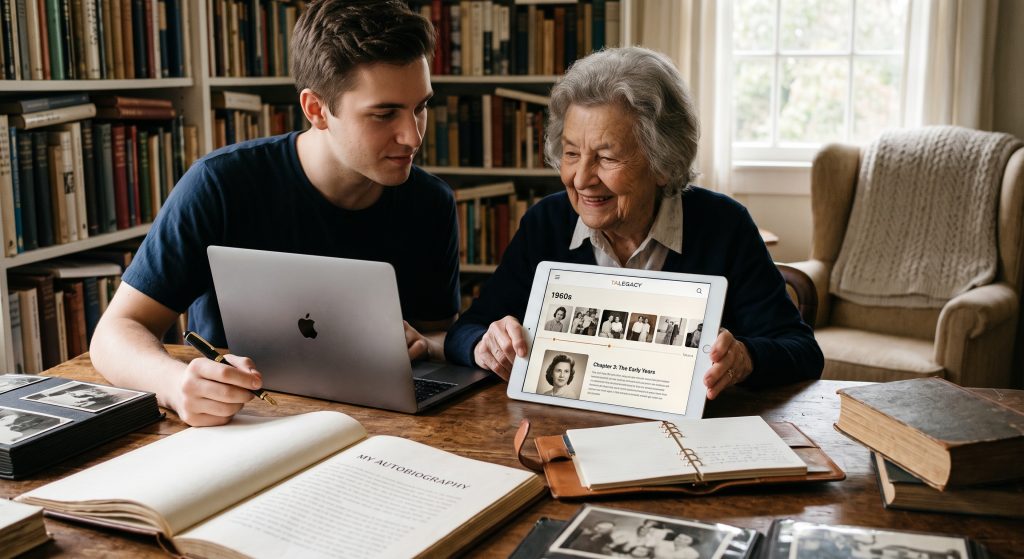
TaLegacy is a platform designed specifically for this purpose: to guide anyone—even those who have never written anything before—in creating their own biography (or that of a loved one), without the AI ever inventing anything on the author’s behalf. Here’s how it works, in a nutshell:
- You tell your story in your own words, even off the cuff. No need for an outline or script: you can simply start telling your story—“I was born in [city], then we moved to…”—and from there, the guided tour will help you delve deeper with targeted questions.
- You can also answer orally, not just in writing—which is especially helpful for those (perhaps a parent or grandparent) who prefer to tell a story by speaking rather than writing.
- AI organizes your answers into well-written sections, preserving your voice and your facts, without adding anything you didn't say.
- If you prefer to write on your own, there’s also a standalone mode: you write your chapters and ask the AI to step in only for structure or proofreading, whenever you want.
- The result is a complete digital manuscript, which you can keep as is or—for an additional fee—turn into a printed book, an audiobook narrated by you, or publish on Amazon with personalized support.
- For those who want to delegate everything, a professional ghostwriting service is also available, with in-person interviews for those who prefer to speak with a real person rather than an interface.
The course is available in 5 languages. With the monthly subscription, you can write multiple biographies over time at a lower cost per project—which is useful if you plan to tell the stories of other loved ones in the future—while the one-time payment option is designed for those who want to complete just one book.
Practical Tips for Getting Started, With or Without AI
No matter which tool you choose, there are certain habits that really help you get off to a good start:
- Don't start at the beginning. Starting with your birth is often the hardest way to begin. Many people find it more natural to start with a vivid memory—a specific moment, a smell, a phrase they heard—and let the timeline piece itself together from there.
- Record conversations with your older loved ones as soon as possible. Memories fade quickly, and some details exist only in the memories of those who lived through them.
- Don't wait until you have "everything clear in your head." Writing (or storytelling guided by questions) helps bring out memories that, on their own, would never resurface.
- Accept that the first draft won't be perfect. A biography is built in layers: you write, you reread, you add, you correct.
In summary
Writing your own biography no longer requires you to be an experienced writer, nor does it mean you have to tackle months of disorganized work on your own. A process guided by artificial intelligence—provided it adheres to one clear principle: never making anything up for you—can transform scattered memories into a real, complete, well-written book in far less time than you might think.
Start writing your biography for free, no credit card required →