
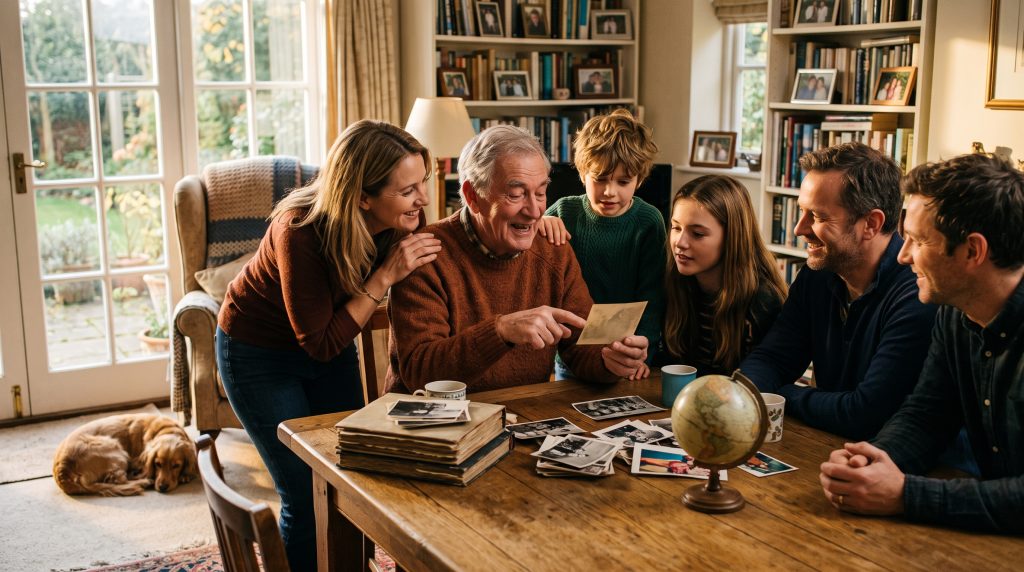
Every family carries within it a story that no one has ever put down in writing: where the grandparents came from, how they met, and what difficult choices shaped the generations that followed. This story exists, scattered throughout the memories of many people, but it fades a little more with each generation that passes without passing it on. Telling your family’s story isn’t just for genealogy enthusiasts—it’s something anyone can do who simply wants to preserve a record of what would otherwise be lost.
Telling your family's story isn't the same as doing genealogy
These two approaches are often confused, but they serve different purposes:
Genealogy reconstructs a family tree: who is descended from whom, on what dates, and in what places. It relies on civil registration records, registers, and official documents.
Telling your family’s story goes beyond mere dates: it’s about the circumstances of a meeting, the courage to set out on a new journey, a tradition passed down without knowing where it came from, or a phrase repeated by a grandmother. It’s the human context that neither a birth certificate nor a family tree can capture.
The two approaches complement each other well: the family tree provides the structure, while the family story brings it to life.
Why This Story Might Be Lost
There are several reasons why family history is being passed down less and less:
- Families are more geographically dispersed than in the past, which reduces opportunities for informal conversation between generations
- Some memories exist only in a single person’s mind —when that person is gone, that fragment of history disappears with them
- No one thinks to ask the questions at the right time: we assume there will always be time later
- Oral accounts become distorted from one generation to the next if they are never recorded in writing
Where to Start When Researching Your Family History
There are a few principles that help structure this process, whether it is carried out on your own or with a tool:
Start with one person, not the whole family at once. Asking a grandparent about their own story is simpler and more rewarding than trying to piece together the entire family history all at once.
Start with specific questions rather than a framework that’s too broad. “Tell me about your childhood” often does more harm than good. “Where did you live when you were ten, and what was a typical day like?” is a much better way to start the conversation.
Let the digressions come. The most valuable details often emerge on the fringes of the question asked, not in the direct answer.
Record or take notes as you go. Memories of the conversation fade quickly; anything that isn’t recorded right away is lost almost as quickly as if it had never been said.
What It Takes to Turn These Memories Into a Real Story
Collecting memories is the first step; turning them into a readable and coherent text is another, often more difficult one:
- Organize chronologically or by theme —memories shared in conversation rarely come in order
- Connecting the fragments — an isolated memory takes on its full meaning once it is linked to the rest of one's life journey
- To put into a coherent written form what has been recounted orally, often in a fragmented or repetitive manner
How TaLegacy Supports This Type of Project
TaLegacy is designed to turn this kind of family project into a tangible book, without requiring any special skills:
- A series of guided questions designed to bring out specific memories rather than general impressions that are difficult to describe.
- The option to provide an oral response—ideal when a grandparent is telling their story directly, or when you’re transcribing what they’ve shared with you.
- AI organizes without ever inventing: the recounted memories are organized into a coherent text, without any details being added or distorted.
- A result that becomes a real book, with a physical print available as a paid option—an item the whole family can keep and pass down to future generations.
The experience is available in 5 languages, with a subscription plan designed for those who want to tell the stories of multiple family members over time, or a one-time payment for a single project.
In summary
A family’s history isn’t recorded anywhere until someone takes the time to document it. This isn’t a project reserved for genealogists or special occasions: it’s a simple process that begins with a conversation and, with the right guidance, can become a book that will be treasured by many generations.